


At our practice, the health and safety of your pets, your family, and our veterinary team is our highest priority. To maintain a safe clinic environment, we operate a strict screening policy for Canine Brucellosis (Brucella canis) aligning with the proactive screening guidance by the UK Government.
Please review the information below to see how this policy applies to your dog:
What is Brucella canis?
Brucella canis (often called B. canis) is a type of bacteria that can cause infection in dogs. It is endemic to some parts of the world, especially Eastern Europe, but is not thought to be widespread in the UK. However, dogs who have travelled or been imported from abroad can sometimes carry it.
Why it matters: Brucella canis is a zoonotic disease, meaning it can be transmitted from dogs to humans. While the risk to the general public is low, it can be higher for people who are pregnant, have young children, or have weakened immune systems.
It’s mainly spread through close contact with infected body fluids (for example, during whelping or handling blood or urine).
Our Screening Policy
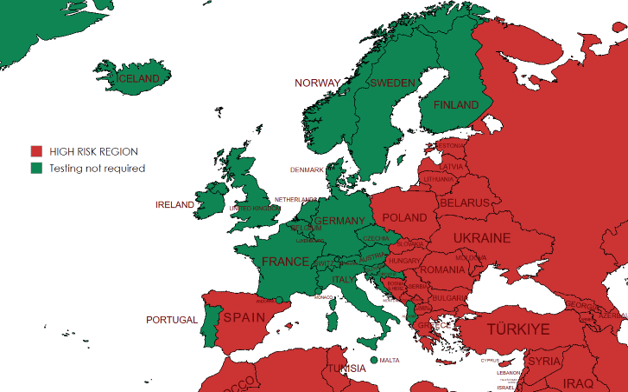
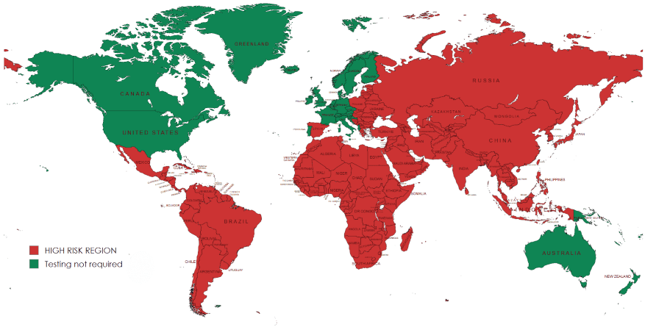
All dogs with a travel history to certain countries listed by the UK Health Security Agency unless in possession of a confirmed APHA negative test performed more than 3 months after latest exposure event (travel abroad).
(Click on link to see listed countries and Map)
Many infected dogs show no outward symptoms but can still spread the bacteria. Therefore, we require screening for any dog considered "at-risk."
Your dog is considered at-risk if they meet any of the following criteria:
- Imported pets: The dog was born outside of the UK or rescued from abroad.
- Travel history: The dog has travelled outside of the UK.
- Breeding history: The dog has mated with, or is the offspring of, an imported dog.
Please see Map and listed countries below
Routine Appointments: Laboratory APHA Testing
For all routine, elective, or non-urgent veterinary care (such as vaccinations, routine check-ups, or neutering), at-risk dogs must have an official laboratory test completed beforehand.
- APHA Test: Blood samples must be sent directly to the government's official laboratory, the Animal and Plant Health Agency (APHA). They run two highly accurate tests in tandem (SAT and iELISA) to ensure maximum safety.
- The 90-Day Rule: The blood sample must be taken at least 3 months (90 days) after the dog arrived in the UK or after their last potential exposure. Tests done before this window may miss an early infection.
- Advance Notice: APHA results can take 7 to 21 days to process. You must provide a copy of the official laboratory certificate showing a negative result before your routine appointment can be booked.
If your dog falls into any of the categories above, they must have a negative laboratory blood test for Brucella canis before they can be booked for routine or non-urgent veterinary care.
- The 90-Day Rule: The blood test must be performed at least 3 months (90 days) after the dog arrived in the UK or after their last potential exposure. Tests done before this window may not detect the bacteria.
- Proof of Testing: You must provide a copy of the official laboratory certificate showing a negative result before we can clear your dog for standard appointments.
What if my imported dog needs urgent emergency care?
We will never turn away an animal in need of emergency, life-saving treatment.
If an untested, at-risk dog requires urgent medical attention:
- Please call us immediately so we can prepare.
- Our team will wear full Personal Protective Equipment (PPE), including gowns, masks, goggles, and gloves.
- Emergency Lateral Flow Test will be performed on arrival as a preliminary screening tool
Symptoms to Watch For
If your dog was not imported but shows any of the following signs, please notify our team so we can safely investigate:
- Recurrent lameness, severe back pain, or difficulty walking.
- Unexplained lethargy, low-grade fevers, or swollen lymph nodes.
- Miscarriages, stillbirths, or fertility issues.
What happens if a dog tests positive?
Brucella canis is a reportable disease in the UK. If a test comes back positive, we are legally required to notify the Animal and Plant Health Agency (APHA).
Because the bacteria cannot be completely cured by antibiotics, a positive diagnosis requires a very sensitive, open discussion between you and our veterinary team regarding safe long-term management and the risks to your household.
Need to arrange a test?
If you need to book a Brucella canis screening test for your pet, or if you have questions about an upcoming appointment, please get in touch.
- 📞 Call us: 01827 63841 (Tamworth), 01827 7207200 (Atherstone)
- 🌐 External Resources: For more information, visit the BVA Brucella canis Advice Hub.
Listed Countries